Credibility & Perspective
About the Author
Each SH Parent Resource Center article is written by an experienced educator and family therapist and provides research-informed guidance grounded in practical classroom experience and a family-systems perspective. The resources are designed to help families better understand school challenges, learning habits, behavior, communication, and emotional development while providing realistic strategies that can be used at home and in partnership with schools.
Parent Resource Library
Parent-Child Communication & Emotional Support
Free Parent Resource
How to Talk With Your Child About a Mistake Without Turning It Into a Lecture
Parent-Child Communication & Emotional SupportProtected PDFFree
Topic
When a child makes a mistake, parents often have more to say than the child can absorb. A long lecture may feel productive to the adult but can shift the child’s attention from understanding the mistake to surviving the conversation. Start with listening.
Research Basis
Supported by guidance and research from Centers for Disease Control and Prevention and American Academy of Pediatrics.
Included Activity
Ten-Minute Mistake-to-Repair Conversation. Use this page after emotions settle. The goal is to understand, repair, and return responsibility to your child.
View / Download PDF
Free Parent Resource
Helping a Child Manage Test Anxiety Before It Takes Over
Parent-Child Communication & Emotional SupportProtected PDFFree
Topic
Some nervousness before a test is common. The problem begins when worry becomes so strong that a child cannot prepare effectively, sleep normally, think clearly during the test, or recover afterward. Start by separating preparation from panic.
Research Basis
Supported by guidance and research from American Psychological Association, American Academy of Pediatrics, and Child Mind Institute.
Included Activity
Ten-Minute Test-Anxiety Preparation Plan. Use this page before a test. The goal is to turn a vague fear into a realistic preparation and coping plan.
View / Download PDF
Free Parent Resource
When Small Problems Lead to Big Reactions
Parent-Child Communication & Emotional SupportProtected PDFFree
Topic
A broken pencil, a changed plan, a sibling comment, or a difficult homework problem can sometimes trigger a reaction that looks much larger than the event itself. During the reaction, arguing about whether the problem is “really a big deal” usually adds fuel. Start with regulation, then problem-solving.
Research Basis
Supported by guidance and research from American Academy of Pediatrics, Center on the Developing Child at Harvard University, and Centers for Disease Control and Prevention.
Included Activity
Ten-Minute Big-Reaction Pattern Review. Use this page after everyone is calm. The goal is to notice escalation earlier and choose one better response.
View / Download PDF
Free Parent Resource
Helping a Child Who Says, “I’m Just Not Good at School”
Parent-Child Communication & Emotional SupportProtected PDFFree
Topic
When a child says, “I’m just not good at school,” the statement can quickly become more than frustration about one assignment. It can turn a temporary difficulty into a fixed conclusion about ability. Start by narrowing the statement to the specific school experience that triggered it.
Research Basis
Supported by guidance and research from American Academy of Pediatrics.
Included Activity
Ten-Minute “Not Yet” Confidence Reset. Use this page after a discouraging school moment. The goal is to separate one difficulty from the child’s identity.
View / Download PDF
Free Parent Resource
Teaching Your Child to Solve Problems Before Asking an Adult to Fix Them
Parent-Child Communication & Emotional SupportProtected PDFFree
Topic
Children need adults for safety, guidance, and support, but they also need repeated chances to handle manageable problems. If an adult immediately fixes every forgotten item, disagreement, difficult task, or minor frustration, the child can learn to look outward for rescue before looking inward for a strategy.
Research Basis
Supported by guidance and research from American Academy of Pediatrics and Center on the Developing Child at Harvard University.
Included Activity
Ten-Minute Try-It-First Problem-Solving Plan. Use this page for a safe everyday problem. The goal is to build a habit of thinking before rescue.
View / Download PDF
Recommended Product
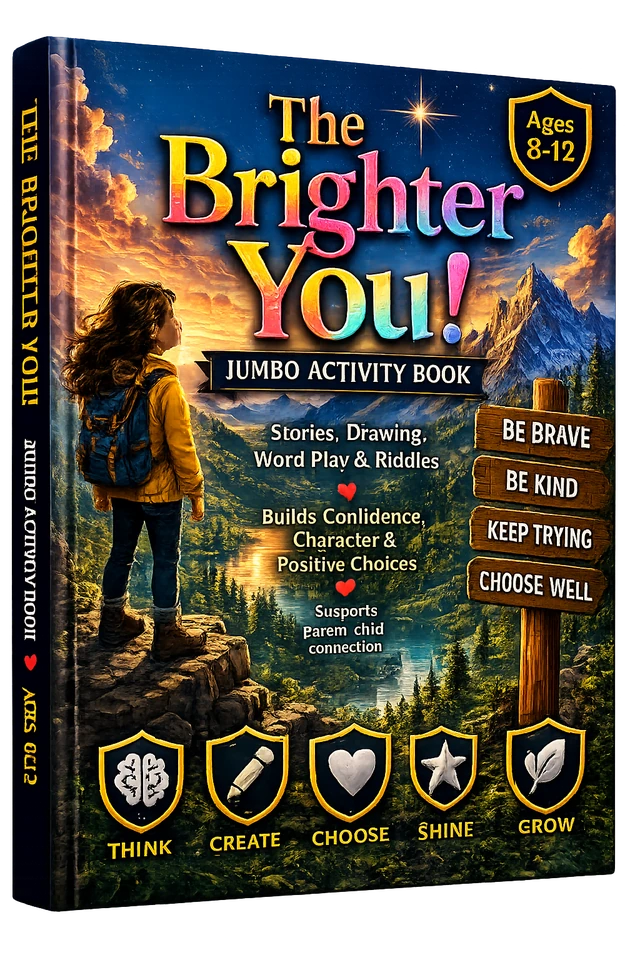
The Brighter You! Jumbo Activity Book
SH-K12 maintains a working relationship with Bilingual Learning Zone (BLZ) and highlights selected educational resources that complement our support for families.
Designed for ages 8–12, The Brighter You! combines stories, drawing, word play, riddles, and reflection activities that encourage confidence, character, creativity, self-awareness, positive choices, and parent-child connection through play.
Ages 8–12254 PagesStories • Drawing • Word Play • Riddles